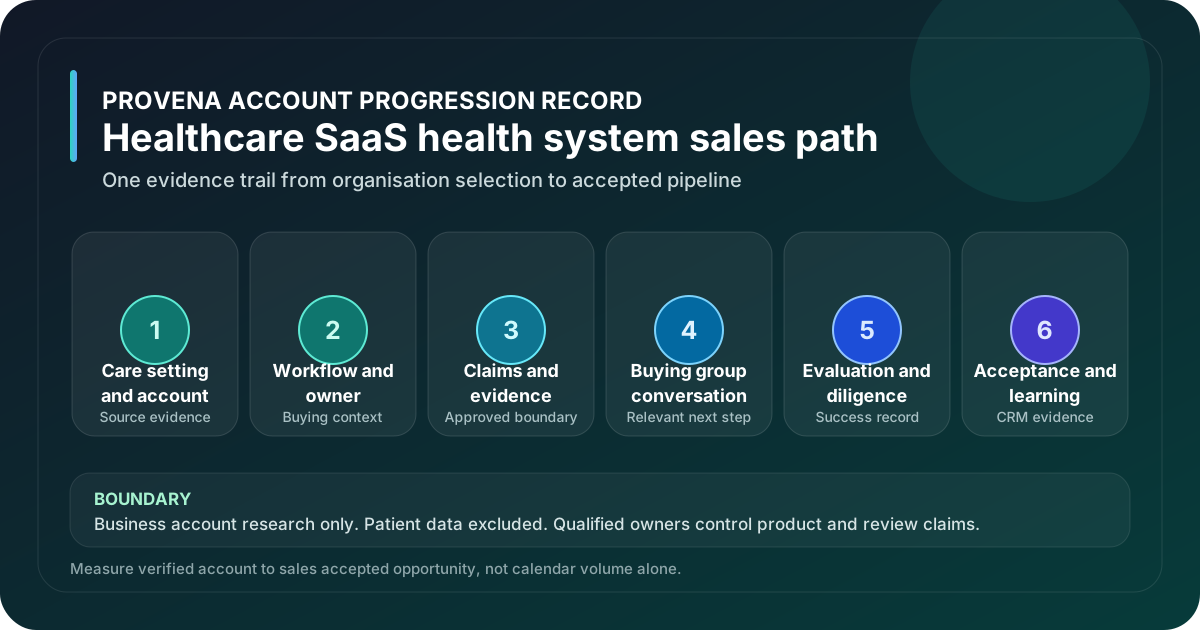
Health system customer acquisition is not a title list and a meeting quota. The product category, care setting, workflow, deployment boundary, evidence and implementation capacity determine which organisations and people are relevant. Build outreach around a supportable operational problem, not a generic innovation claim. Keep patient and health information outside prospecting. Measure the route from a verified organisation to a sales accepted opportunity, including the diligence and rejection evidence that explains progress.
Each company links to an official product page or primary source relevant to this guide. Monogram tiles identify the referenced organisation and do not imply endorsement.
Sell healthcare SaaS to health systems by choosing one care setting and workflow, building a source verified account market, mapping the operational champion and the complete review group, and preparing approved product evidence before outreach. Use business contact information only. Direct outreach can open a relevant conversation, but the sales path must carry implementation, integration, privacy, security, clinical, finance and procurement questions to accountable owners. Propose a contained evaluation with written success evidence and treat a meeting as qualified only when the account, attendee, problem and next commitment meet the acceptance rule.
How should a healthcare SaaS company sell into a health system?
A revenue cycle platform, clinical workflow tool, interoperability product and practice operations system can all be called healthcare SaaS while entering different organisations, review paths and risk boundaries. The daily user may not own budget. An operational sponsor may still need clinical, information technology, security, privacy, finance, procurement and executive review before a useful evaluation can begin. The answer must fit the buyer, the people doing the work and the evidence available after launch. A fashionable platform or generic checklist cannot repair weak targeting or unclear ownership.
Choose one organisation segment, one accountable workflow, one approved outcome and one evidence backed next step. Then define the buying group, excluded accounts, data boundary, product review route and sales acceptance rule before purchasing data, writing messages or setting a meeting target. Write the desired business outcome first, then define what must be true for it to occur and which risks require a human decision.
How should healthcare SaaS founders, marketing leaders and revenue teams approach healthcare SaaS sales to health systems?
We reviewed current primary material from CMS, HHS, ONC, FDA, FTC and Google on 28 August 2026. Those sources define public organisation data, implementation, certification, cybersecurity, product, privacy and sender boundaries. The six stage account progression record is independent Provena editorial analysis. This playbook does not decide which regulation, certification or clinical review applies to a product. Qualified product, clinical, privacy, security and legal owners must make those decisions. For healthcare SaaS sales to health systems, we used documented capability and practical fit. No paid placement, invented scores or unsupported performance claims were used. Check current pricing and packaging directly.
Step or choice
Best fit
Desired outcome
Risk to manage
Care setting and account evidence
teams narrowing a broad healthcare market into organisations that can use the product
a finite source verified market with explicit fit and exclusion rules
public records establish organisation facts but do not prove a current need or create government endorsement
Workflow and accountable owner
products that change clinical, administrative, revenue, data or operational work
messages and discovery centre the real job, owner and implementation context
the visible user, operational champion, budget owner and review owners may be different people
Approved outcome and product claims
teams preparing category education, outbound messages, demos and sales material
every commercial claim has a product owner, evidence and limitation
unqualified language about outcomes, interoperability, certification, security or compliance can damage trust and create risk
Buying group and first conversation
healthcare SaaS teams using cold email, LinkedIn, content or partner routes to start demand
a relevant buyer understands the workflow problem, evidence boundary and reason for a conversation
high meeting volume can hide wrong accounts, junior attendees and conversations with no review path
Evaluation and diligence path
products that require workflow validation, technical review, security evidence or implementation planning
the buyer can test value and risk without treating a demonstration as proof
a vague pilot can consume clinical and technical time while producing no decision evidence
Sales acceptance and learning
teams connecting appointment setting with revenue operations and executive review
pipeline reflects accepted commercial progress and preserves why accounts advance or stop
booked meetings and influenced pipeline can be counted without a shared acceptance rule
A practical comparison for healthcare SaaS sales to health systems, from each option's public materials.
Provena healthcare SaaS account progression framework. Keep one evidence record from organisation selection through sales acceptance.
What belongs in a healthcare SaaS account progression record?
Start with public organisation evidence. The CMS Provider Data Catalog publishes official information about Medicare certified hospitals and other healthcare providers. Use public organisation characteristics to support account research, then verify current facts at the organisation source. CMS data is not an endorsement and should not be used to imply one.
Record one workflow and the people affected by it. ONC guidance says successful health information technology implementation must consider care processes, technology, people, communication and organisational culture. A sales brief should therefore name the operational user, workflow owner, integration and implementation context instead of reducing the account to an executive title.
Separate product evidence from acquisition activity. ONC certification requirements apply to health information technology modules participating in that programme. FDA guidance distinguishes software functions that may fall within medical device oversight from functions that do not. The sales team should record the product owner's approved position and route uncertain questions to qualified owners rather than improvising a certification or regulatory claim.
Make security review visible before it becomes an objection. HHS healthcare cybersecurity goals cover controls such as asset inventory and third party vulnerability disclosure. They are not a universal procurement checklist, but they show why a software seller should know who owns security evidence, product dependencies, incident response and vendor review before promising a deployment.
Keep outreach within a business acquisition boundary. HHS and FTC guidance show that privacy obligations depend on the product, entity, relationship and information involved. Patient information is not required to identify healthcare organisations and professional buyers. The FTC says commercial email has no business to business exception, while Google publishes sender authentication and unsubscribe requirements.
Which parts of healthcare SaaS sales to health systems deserve attention first?
Care setting and account evidence: what changes in practice?
Define the care setting, organisation type, geography, scale, relevant service or workflow, technology requirement and excluded accounts. Use public CMS and organisation sources where appropriate, record the source and date, and label any commercial trigger as an inference until a buyer confirms it. Do not add patient or health information to the account record. Suits teams narrowing a broad healthcare market into organisations that can use the product. Strongest where a finite source verified market with explicit fit and exclusion rules matters. Test that public records establish organisation facts but do not prove a current need or create government endorsement.
Workflow and accountable owner: what changes in practice?
Map the present workflow, recurring exception, people affected, authoritative system and accountable outcome. Identify the daily user, operational sponsor, clinical owner where relevant, information technology, integration, security, privacy, finance, procurement and executive roles. Tailor the initial route without pretending one contact can approve the whole purchase. Suits products that change clinical, administrative, revenue, data or operational work. Strongest where messages and discovery centre the real job, owner and implementation context matters. Test that the visible user, operational champion, budget owner and review owners may be different people.
Approved outcome and product claims: what changes in practice?
Create an approved claim register before launch. For each statement, record the product capability, intended setting, evidence, limitation, accountable reviewer and date. State whether ONC certification, FDA oversight or another review is relevant only after qualified owners determine the actual product boundary. Outreach staff should escalate questions rather than invent an answer. Suits teams preparing category education, outbound messages, demos and sales material. Strongest where every commercial claim has a product owner, evidence and limitation matters. Test that unqualified language about outcomes, interoperability, certification, security or compliance can damage trust and create risk.
Buying group and first conversation: what changes in practice?
Use source verified business contacts, an approved message and a clear stop rule. Explain the workflow hypothesis and why the account may fit, then ask for correction or a contained conversation. A qualified first meeting needs account fit, a relevant attendee, an acknowledged problem, an agreed purpose and a specific next commitment. Suits healthcare SaaS teams using cold email, LinkedIn, content or partner routes to start demand. Strongest where a relevant buyer understands the workflow problem, evidence boundary and reason for a conversation matters. Test that high meeting volume can hide wrong accounts, junior attendees and conversations with no review path.
Evaluation and diligence path: what changes in practice?
Propose a contained evaluation with scope, owners, approved users, data boundary, integrations, security review, success measures, support, decision date and exit conditions. Use representative non sensitive or properly governed data chosen by accountable owners. Record every diligence request and answer so marketing, sales, product and implementation use the same approved evidence. Suits products that require workflow validation, technical review, security evidence or implementation planning. Strongest where the buyer can test value and risk without treating a demonstration as proof matters. Test that a vague pilot can consume clinical and technical time while producing no decision evidence.
Sales acceptance and learning: what changes in practice?
Record attendance, account and role fit, workflow evidence, objections, diligence status, next commitment, opportunity stage, owner and rejection reason. Sales should accept or reject the handoff against the written rule. Feed repeated evidence gaps back into product, content and targeting, then change one material variable at a time. Suits teams connecting appointment setting with revenue operations and executive review. Strongest where pipeline reflects accepted commercial progress and preserves why accounts advance or stop matters. Test that booked meetings and influenced pipeline can be counted without a shared acceptance rule.
Which review owner must answer each diligence question before a health system buys?
Health system purchases pass through a fixed set of reviews. Preparing the answer and naming the owner for each is most of the sales work.
Review
Question asked
Vendor owner
Prepare before outreach
Clinical or operational
Does this change the workflow safely and usefully?
Product and clinical lead
Workflow evidence for the chosen care setting
IT and integration
How does it connect to the EHR and existing systems?
How should teams put healthcare SaaS sales to health systems into practice?
A workable plan for healthcare SaaS sales to health systems needs a named owner, a contained first test and a review date. First action: Choose one care setting, organisation type, workflow, region and product boundary for the first market. Keep the first cycle narrow enough to learn without hiding a weak assumption inside volume.
Choose one care setting, organisation type, workflow, region and product boundary for the first market.
Build a dated account record from public organisation and first party sources, with explicit exclusions and no patient information.
Map the user, operational sponsor, clinical owner where relevant, information technology, integration, security, privacy, finance, procurement and executive roles.
Create an approved claim register covering product capability, outcomes, implementation, interoperability, security, certification and limitations.
Define a qualified conversation and sales accepted opportunity before selecting channels or setting activity targets.
Assign ownership for domains, mailboxes, business contact data, suppression, messages, CRM records, evidence and response times.
Launch one contained segment through direct outreach, useful content, partner routes or a deliberate combination.
Give evaluation and diligence requests named owners, due dates, approved answers and a visible next commitment.
Review rejected accounts, replies, attendance, acceptance, opportunity creation, stage movement and evidence gaps before expanding.
Record the decision about healthcare SaaS sales to health systems in the campaign brief so the team can revisit it when evidence changes. Keep a dated change log so rules, features and assumptions can be reviewed without rebuilding the whole motion.
Which mistakes are most common in healthcare SaaS sales to health systems?
Execution risk around healthcare SaaS sales to health systems usually begins with unclear ownership or a test that cannot produce useful evidence. Review the following failure modes before the first live cycle.
Treating healthcare as one market without naming the care setting, workflow, organisation and product boundary.
Buying a large title list before defining which organisations can use the product and which roles own the decision.
Using patient or health information in ordinary business prospecting when public organisation and professional contact evidence is sufficient.
Claiming the product is compliant, certified, clinically proven or interoperable without an accountable owner and applicable evidence.
Asking one champion to carry clinical, technical, security, privacy, finance and procurement review alone.
Calling every booked meeting qualified without account fit, a relevant attendee, an acknowledged problem and a next commitment.
Scaling outreach while product evidence, implementation capacity, response ownership or sales follow through remains weak.
This article provides general commercial operating information, not medical, clinical, legal, privacy, security, procurement or regulatory advice. Requirements depend on the product, organisation, relationship, information, use and jurisdiction. Use qualified owners to determine the applicable rules and evidence before outreach or a live evaluation.
Which numbers show progress in healthcare SaaS sales to health systems?
Measure the route from a source verified healthcare organisation to a sales accepted opportunity. Record relevant accounts, verified business roles, delivered messages, replies, qualified conversations, attended meetings, evidence and diligence requests, accepted opportunities, pipeline created, stage conversion, time to response and rejection reasons. Review by care setting, workflow, organisation type, buyer role, trigger and message. Keep patient and health information outside the growth report. Activity explains performance but does not replace commercial acceptance.
How can Provena help with healthcare SaaS sales to health systems?
Provena can support source verified account research, business contact verification, cold email, LinkedIn, organic content, conversion pages, reply qualification and pipeline review for B2B healthcare SaaS. It does not own clinical, legal, privacy, security, regulatory, procurement, implementation or closing decisions, and it has no published healthcare SaaS client case study. A contained programme should begin only when the client can supply approved product evidence and a capable sales owner. For healthcare SaaS sales to health systems, Provena builds the research, data, messaging and operating loop around the chosen route. The goal is not more activity for its own sake. It is a controlled system that creates relevant conversations and shows clearly what should change next. See the B2B SaaS lead generation service and review Provena case studies before deciding whether support is appropriate.
Which sources does this guide to healthcare SaaS sales to health systems draw on?
How do you sell software to hospitals and health systems?
+
Pick one care setting and workflow, build a source-verified list of health systems that run it, and map the operational champion plus the full review group: clinical, IT and integration, privacy and security, finance and procurement. Prepare approved product and outcome claims before any outreach. Business contact information only, one relevant conversation to open, then a sales path that carries every diligence question to an accountable owner. Propose a contained evaluation with written success evidence, and count a meeting as qualified only when the account, attendee, problem and next commitment meet the acceptance rule.
How long is the sales cycle for healthcare SaaS?
+
Long, and set by the review group rather than the champion: security and privacy review, integration assessment, clinical validation, finance approval and procurement each add weeks to months, and a contained evaluation adds its own cycle. Vendors shorten it by preparing security documentation, integration answers and approved evidence before the first conversation, by naming the accountable owner for each review, and by proposing a bounded evaluation with a written decision date rather than an open pilot.
Can you cold email hospital executives?
+
You can email business contacts about a business product, with the same relevance, accuracy and opt-out duties that apply to any B2B outreach, and with no patient or clinical data anywhere in the process. What a cold email can do is open one relevant conversation with the operational champion; it cannot carry the sale. The message should name the care setting and workflow, use only approved claims, and propose a small next step. Anything that looks like a generic software pitch is deleted by people who receive many of them.
Which risk should teams watch with healthcare SaaS sales to health systems?
+
Two, for healthcare SaaS sales to health systems. First: Treating healthcare as one market without naming the care setting, workflow, organisation and product boundary. Second: Buying a large title list before defining which organisations can use the product and which roles own the decision.
How can Provena support work around healthcare SaaS sales to health systems?
+
Provena can support source verified account research, business contact verification, cold email, LinkedIn, organic content, conversion pages, reply qualification and pipeline review for B2B healthcare SaaS. It does not own clinical, legal, privacy, security, regulatory, procurement, implementation or closing decisions, and it has no published healthcare SaaS client case study. A contained programme should begin only when the client can supply approved product evidence and a capable sales owner. For work on healthcare SaaS sales to health systems, review Provena's B2B SaaS lead generation service and confirm fit in a conversation before choosing support.
Research briefing
Join the Vertical SaaS Growth Briefing
Receive new research on niche market selection, buyer intent, customer acquisition and qualified pipeline for B2B software teams.
Turn this research into qualified pipeline.
Thirty minutes on your market, your pipeline constraint and the next practical step, including where Provena does not fit.